Solar System & Missions
Olympus Mons: How Big Is the Solar System's Largest Volcano?
Quick answer
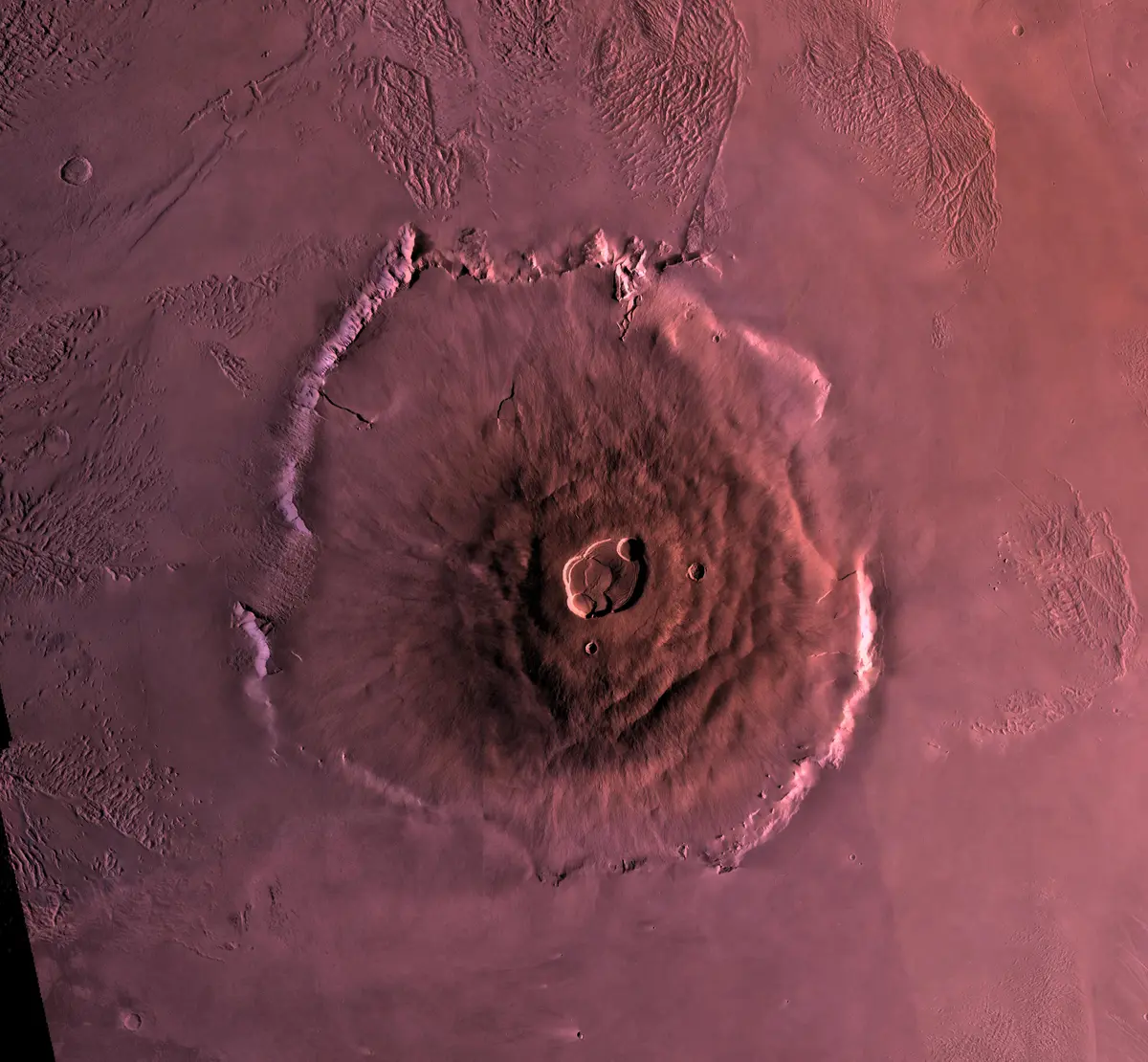
Olympus Mons is about 22 km (14 miles) tall above the plains around it, according to ESA, roughly 2.5 times the height of Mount Everest. NASA puts its width at 550 to 600 km. It is a shield volcano built by runny lava, and Mars let it grow this large because of its weak gravity and a crust that does not move in plates.
On this page
Every planet has its record holders, and Mars owns one of the biggest in the Solar System: a volcano roughly two and a half times as tall as Mount Everest and wide enough to cover a state.
The exact numbers are less settled than the headlines suggest. Below: how big Olympus Mons is according to NASA and ESA, why Mars could build something like this, and why you will see more than one height quoted.
How big is Olympus Mons?
About 22 km tall above the surrounding plains, according to ESA's Mars Express images from 2013, and several hundred kilometers wide. For the width, NASA's figure is 550 km in a 1997 article and "over 600 kilometers at the base" in the caption of a digital mosaic of the volcano. The same NASA page says the base covers an area as large as the state of Arizona.
| Measure | Figure | From |
|---|---|---|
| Height | About 22 km | ESA, 2013 |
| Height | 24 km | NASA, 1997 |
| Height | 25 to 26 km | ESA overview |
| Width | 550 km | NASA, 1997 |
| Width at base | Over 600 km | NASA mosaic |
| Summit caldera | 25 km wide, almost 3 km deep | NASA mosaic |
| Cliff around it | Up to 6 km (NASA), up to 9 km (ESA) | NASA, ESA |
Olympus Mons figures from NASA and ESA pages. Sources are listed at the end. Read November 9, 2026.
The rows do not match because they come from different spacecraft and years. In my reading, the bigger reason is that Mars has no sea level to measure from, so a height depends on where you put the bottom. The volcano also ends in a cliff, which makes the "base" hard to pin down. One NASA page lists the volcano as more than 25 miles (about 40 km) tall from base to summit. That is far above every other NASA and ESA figure I read, so I do not use it.
So the honest answer is a range: somewhere between 22 and 26 km tall, depending on the source, and 550 to 600 km wide.
How does Olympus Mons compare with Mount Everest?
It is more than double the height of Everest. NASA gives Everest as 8,848 meters above sea level, and 22 km divided by 8.8 km is about 2.5 (my calculation). ESA's older Mars Express overview puts it at 26 km, which it describes as Everest being only one third as high. NASA's 2023 Astronomy Picture of the Day says three times higher.
Earth's own giant volcanoes look small next to it. ESA says Olympus Mons is more than double the height of Mauna Kea, the tallest volcano on Earth, at 10 km when measured from its base on the ocean floor. NASA's 1997 article gives Earth's largest volcano, Mauna Loa, as 9 km high and 120 km across. Olympus Mons is more than four times as wide as that (my calculation).
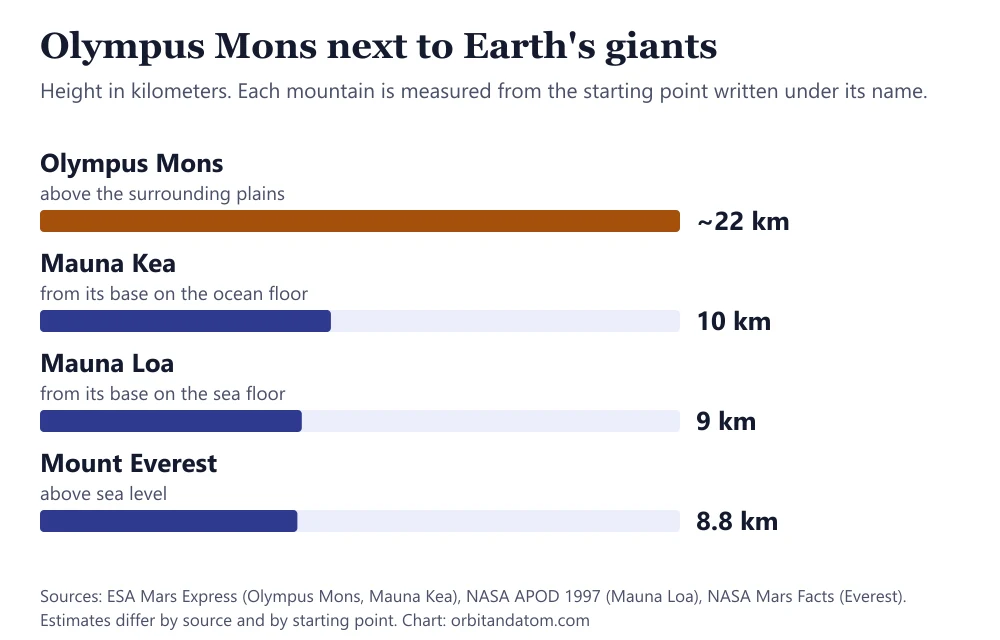
NASA's 2023 picture article adds one more comparison: the volcano covers an area greater than the whole Hawaiian volcano chain.
To see how big Mars itself is next to the other planets, check the sizes and distances in my guide to the eight planets in order.
Would you notice you were climbing it?
Barely, at least on the flanks. NASA says the slopes of Olympus Mons typically rise only a few degrees at a time, and its Astronomy Picture of the Day adds that the shallow slopes and Mars's low gravity would make it easy for humans to climb. That is why a mountain this tall looks like a gentle dome from above.
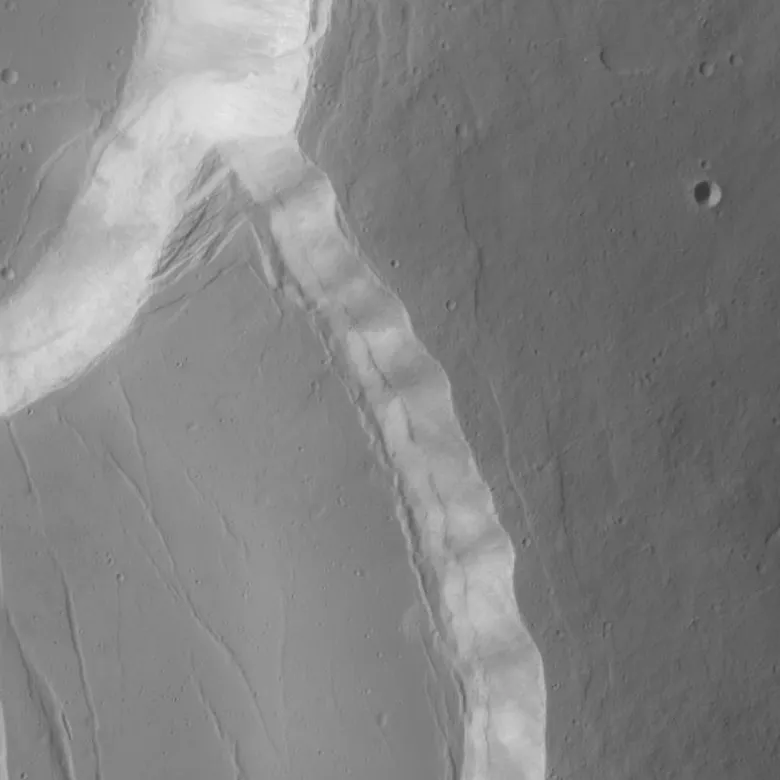
The exception is the edge. ESA says that, unlike other shield volcanoes, Olympus Mons ends in an abrupt cliff, called a scarp, that circles the whole volcano and reaches up to 9 km high in places. NASA's mosaic caption gives up to 6 km. Either way, the walk would end at a wall.
Why is Olympus Mons so much bigger than any volcano on Earth?
Two things, according to NASA: Mars has low gravity and its surface has no tectonic motion. NASA calls Olympus Mons a shield volcano, built up layer by layer from fluid lava, so the lava kept flowing and piling up in the same place.
ESA's explanation of the planet's interior adds the second half. There is no evidence of plate tectonics on Mars, the process on Earth by which crust is made and recycled. ESA says the lack of recycling is thought to explain why the Martian volcanoes grew so large: movements of the crust never disturbed them. In my reading, that means a volcano stayed over the same supply of lava for as long as it kept erupting.
The ground under the volcano also seems to matter. A 2012 study described on ESA's Mars Express pages finds that Olympus Mons is built on a rigid lithosphere, while the nearby Tharsis Montes volcanoes partly sank into a less rigid one.
For another piece of the story, see why Mars is red, which covers the rusty dust that coats these same lava plains.
What caused the cliff around Olympus Mons?
Probably giant landslides. ESA says the scarp was likely formed during a number of catastrophic landslides on the flanks of the volcano, with the debris carried several hundred kilometers beyond the edge. NASA's mosaic page describes a ridged and grooved deposit around the volcano, called the aureole, and says its origin is controversial but may be related to material sliding off the flanks of an older volcano.
ESA's images also show hundreds of individual lava flows on the volcano's sides, including the remains of a collapsed lava tube. Flows that stopped before the cliff end in rounded tongues, ESA says, as the lava cooled and crept to a halt.
Is Olympus Mons still active?
Not as far as the sources I read say. NASA's 2023 article says its last eruption is thought to have been about 25 million years ago. ESA says the volcanic region that hosts Olympus Mons and several other large volcanoes is thought to have been active until tens of millions of years ago, and calls that recent on a planet whose history spans 4.6 billion years.
ESA's evidence is the surface itself. The area around the volcano has only a few small impact craters, which means it is relatively young compared with more heavily cratered regions of Mars. None of the pages I read reports an eruption in modern times.
Where is Olympus Mons on Mars?
On the western edge of the Tharsis region, a bulge ESA describes as 10 km high and 4,000 km wide. Running roughly along the equator from the eastern side of that bulge is Valles Marineris, the canyon system NASA calls the largest in the Solar System. NASA describes it as 3,870 km long, which makes Mars home to both the largest volcano and the largest canyon in the Solar System.
You can look for the planet itself in the sky this month, even if you cannot see its volcano. In my guide to the planets in November 2026, Mars is a morning object that passes close to Jupiter on November 16. Mercury, the innermost planet, has its own record: no spacecraft has ever landed on it.
In my opinion, the width is the more striking number than the height. Slopes of only a few degrees spread over 550 km are why Olympus Mons looks like a gentle dome from orbit rather than a peak.
Frequently asked questions
How tall is Olympus Mons?
About 22 km above the surrounding plains, according to ESA. NASA and ESA pages give figures from 22 to 26 km, because the height depends on where the base is measured from.
How wide is Olympus Mons?
NASA gives 550 km in one article and over 600 km at the base in another. It covers an area as large as the state of Arizona.
Is Olympus Mons taller than Mount Everest?
Yes, by a lot. At about 22 km it is roughly 2.5 times the height of Everest, which NASA gives as 8,848 meters above sea level. The two are measured from different starting points, so it is a rough comparison.
Why did Olympus Mons grow so large?
NASA points to Mars's low gravity and a surface with no tectonic motion. ESA adds that without plate tectonics, volcanoes were never carried away or recycled, so they kept growing.
Is Olympus Mons still erupting?
No eruption is reported in the sources I read. NASA says the last eruption is thought to have been about 25 million years ago, and ESA says the region was active until tens of millions of years ago.
Could you climb Olympus Mons?
NASA says the slopes rise only a few degrees at a time and Mars's low gravity would make it easy for humans to climb. The cliff around the base, up to 6 to 9 km high, is the hard part.
Sources
- ESA, "At the foot of the Red Planet's giant volcano" (Mars Express images from January 21, 2013; accessed November 9, 2026). Used for the 22 km height, Mauna Kea, the scarp, the landslides, the lava flows and the age.
- ESA, "A small planet with dramatic landscapes" (accessed November 9, 2026). Used for the 25 to 26 km figures, the Everest comparison and the Tharsis bulge.
- ESA Science & Technology, "Martian interior" (accessed November 9, 2026). Used for plate tectonics and why the volcanoes grew so large.
- ESA Science & Technology, "Olympus Mons topography" (accessed November 9, 2026). Used for the rigid lithosphere under the volcano.
- NASA, Astronomy Picture of the Day, September 15, 1997, "Olympus Mons on Mars: The Largest Volcano" (accessed November 9, 2026). Used for the 24 km and 550 km figures and Mauna Loa.
- NASA, Astronomy Picture of the Day, April 4, 2023, "Olympus Mons: Largest Volcano in the Solar System" (accessed November 9, 2026). Used for the slopes, the Hawaiian chain comparison and the last eruption.
- NASA Science, "Mars Facts" (accessed November 9, 2026). Used for Everest's height, the Arizona comparison and Valles Marineris.
- NASA/JPL/USGS, "Olympus Mons" (PIA00300)
- NASA/JPL-Caltech/ASU, "Olympus Mons Summit" (PIA17969)

Founder and editor, Orbit and Atom
I write Orbit and Atom to explain space and science in plain English, starting from what NASA, ESA and the mission teams publish. Every article lists its sources at the end so you can read them yourself.