Solar System & Missions
Asteroid Apophis in 2029: Will It Hit Earth?
Quick answer
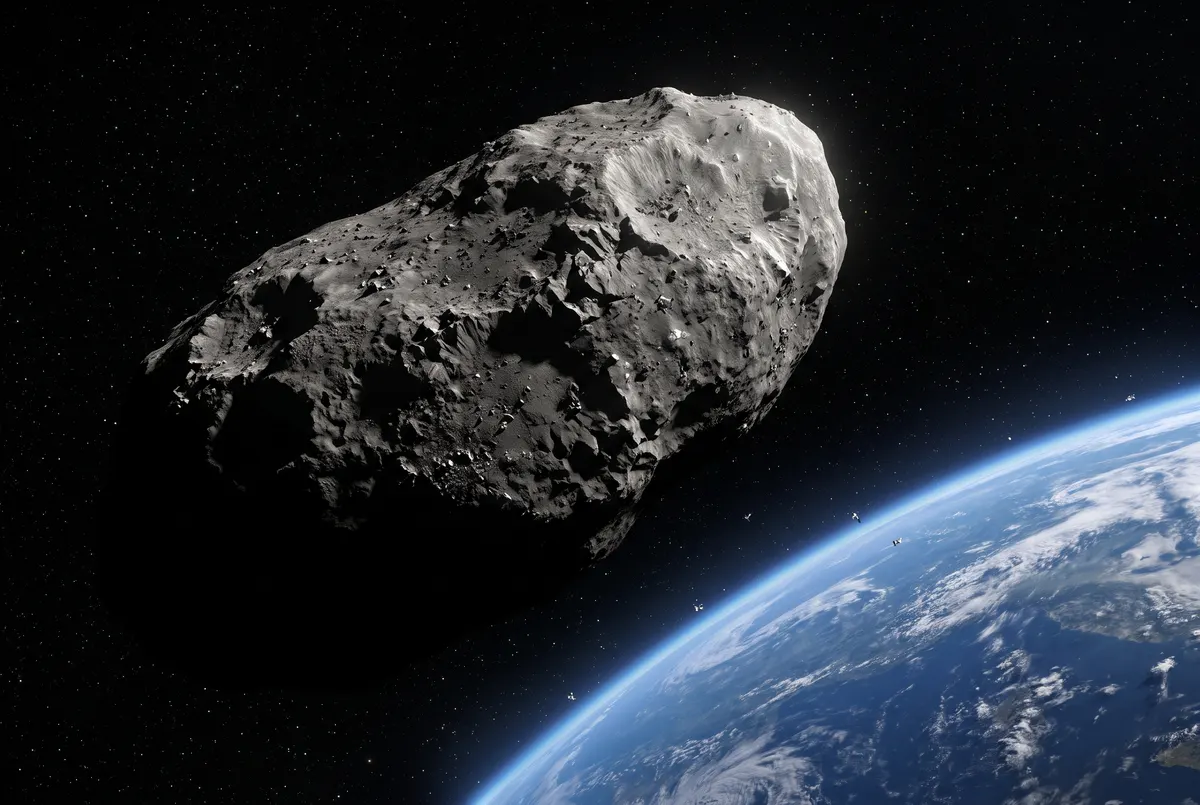
No. NASA and ESA both say Apophis will not hit Earth in 2029, and NASA is confident there is no impact risk for at least 100 years. On April 13, 2029, the roughly 375-meter asteroid will pass about 32,000 km above Earth's surface, closer than many geosynchronous satellites, and people in parts of Europe, Africa and Asia should be able to see it with the naked eye.
On this page
- Will Apophis hit Earth in 2029?
- How close will Apophis come, and how big is it?
- Why did people think Apophis would hit Earth?
- Can you see Apophis with the naked eye?
- What will Earth's gravity do to Apophis?
- Which spacecraft will visit Apophis?
- Does "no risk for 100 years" mean Apophis is harmless forever?
- FAQ
- Sources
Friday, April 13, 2029, sounds like a bad omen, and the asteroid involved was named after the Egyptian god of chaos. Both facts feed the question people keep asking: is Apophis coming for us?
The short answer from the space agencies is no, but the flyby is still one of the most remarkable sky events of the decade. Below: what the two agencies report, who can watch it from the ground, and which spacecraft are heading there.
Will Apophis hit Earth in 2029?
No. NASA says astronomers tracked the asteroid closely and it is now confident there is no risk of Apophis impacting Earth for at least 100 years. ESA reaches the same conclusion and says Apophis poses no risk to Earth during its 2029 flyby.
The scare was real, though, and it explains why the name is still famous. After its discovery in 2004, early observations left a small chance of impact on three dates. Each one was settled by better measurements.
| Year | What was feared | How it was settled |
|---|---|---|
| 2029 | Impact chance rose as high as 2.7% | Ruled out by later observations |
| 2036 | Small chance of impact | Ruled out by later observations |
| 2068 | A small chance remained for years | Ruled out by radar in March 2021 |
Apophis impact dates once considered, and how each was ruled out. Source: ESA, "Apophis" (read November 23, 2026).
ESA says the 2.7% figure gave Apophis the highest rating ever recorded on the Torino scale, the method used to judge how much of a threat an asteroid poses.
How close will Apophis come, and how big is it?
According to NASA, Apophis will pass about 20,000 miles (32,000 kilometers) from Earth's surface on April 13, 2029. That is closer than many satellites in geosynchronous orbit, which NASA puts at an altitude of about 22,236 miles (36,000 kilometers).
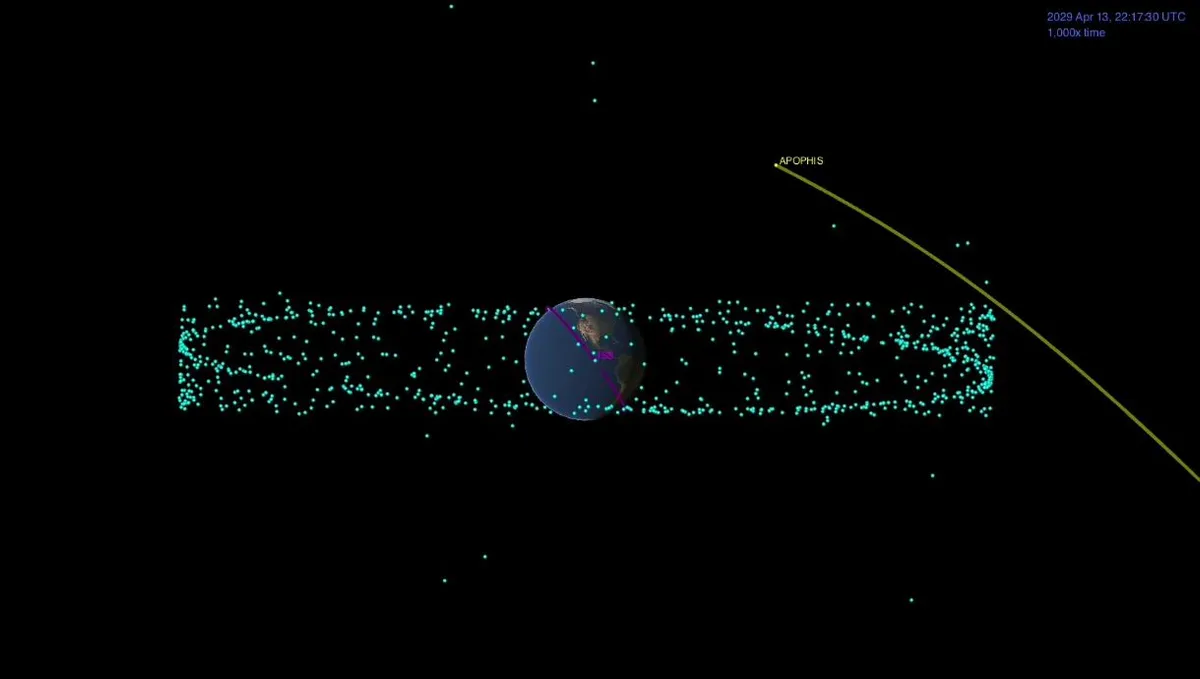
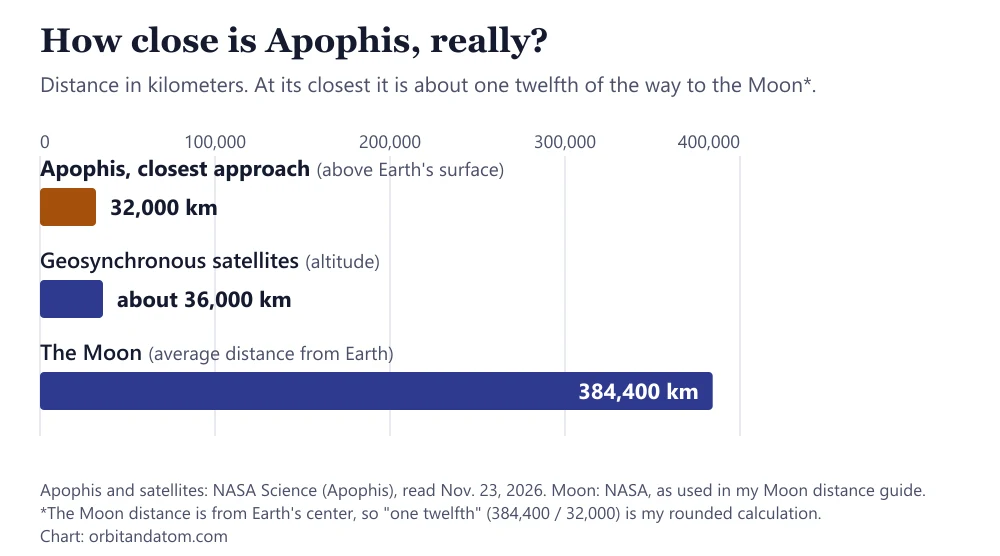
ESA adds that this is less than one tenth of the distance from Earth to the Moon. For an asteroid this size, it is the closest approach humans have known about in advance, according to ESA.
| Fact | Value |
|---|---|
| Official name | (99942) Apophis |
| Discovered | June 19, 2004, Kitt Peak National Observatory, Arizona |
| Size | About 375 m across on average (ESA) |
| Mass | About 20 million tons (ESA) |
| Shape and makeup | Elongated; stony, with silicate rock and nickel-iron (NASA) |
| Closest approach | April 13, 2029, about 32,000 km from the surface |
Apophis at a glance. Sources: ESA, "Apophis"; NASA Science, "Apophis" and "OSIRIS-APEX" (read November 23, 2026).
Sizes differ a little by source. NASA's 2021 radar notes describe the asteroid as 340 meters wide, while ESA uses about 375 meters on average. Apophis is not round, so the number depends on how it is measured.
If you like to compare sizes and distances, the 384,400 km in the chart comes from my piece on the Moon's distance and its slow drift.
Why did people think Apophis would hit Earth?
Because for a few years the numbers genuinely allowed it. Apophis was discovered on June 19, 2004, by astronomers Roy Tucker, David Tholen and Fabrizio Bernardi, according to NASA, and ESA says it was soon identified as one of the most potentially hazardous asteroids ever detected.
The turning point came in March 2021. ESA says radar observations from NASA's Goldstone Deep Space Communications Complex in California and the Green Bank Observatory in West Virginia greatly improved knowledge of the asteroid's orbit. That let astronomers rule out any impact for at least 100 years, and ESA removed Apophis from its Risk List on March 26, 2021.
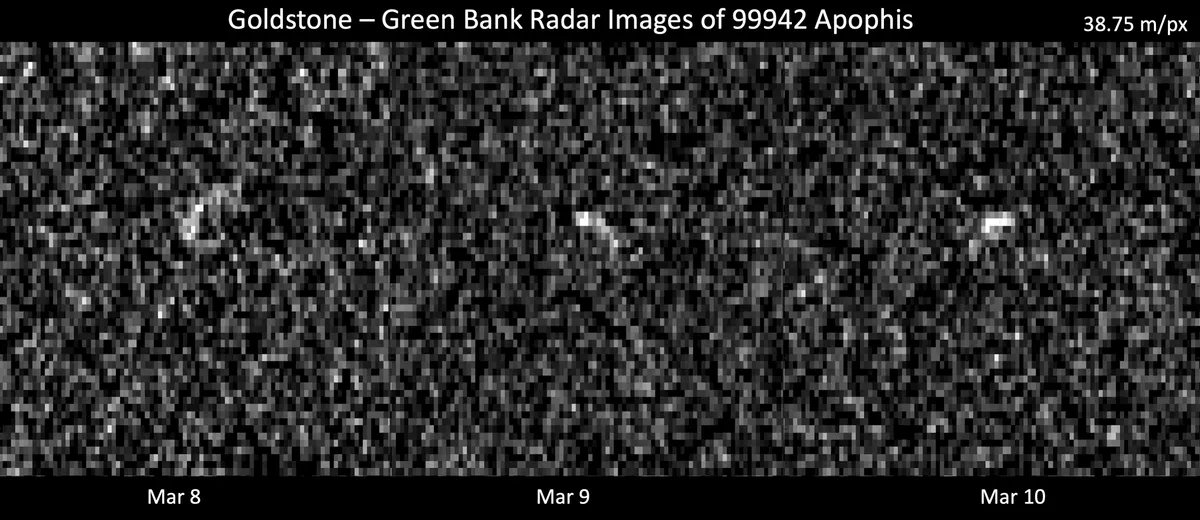
Those grainy images are the ones that closed the case. In my view, the interesting part is not the scare itself but that astronomers turned a 2.7% fear into a firm answer in about 17 years, my count from 2004 to 2021.
Can you see Apophis with the naked eye?
Yes, from the right part of the world. ESA says Apophis will, for a short time, be visible to the naked eye in the night sky from parts of Europe, Africa and Asia. It will look like a moving star, not a disc.
Space.com gives the timing in GMT (the same as UTC): closest approach at 2145 GMT on April 13, 2029, and peak brightness about an hour earlier, at 2035 GMT, at a magnitude of around 3.1. It says that is bright enough to see from dark locations, but only some locations, and lists Europe, Africa and western Asia.
- Closest approach: 21:45 UTC, which is 22:45 in London and 23:45 in Paris or Madrid (my conversions to summer time).
- Peak brightness: 20:35 UTC, according to Space.com.
- Americas: neither ESA nor Space.com lists them. At 5:45 p.m. EDT it is still daylight on the US East Coast, which fits that, though that is my inference.
Exact brightness figures vary between sources, so treat 3.1 as approximate and check a local sky chart closer to the date. For other sky events worth planning around, see my meteor shower calendar and the August 2, 2027 total solar eclipse.
What will Earth's gravity do to Apophis?
It will change the asteroid. ESA explains that the side of Apophis nearest Earth will be pulled harder than the far side, and these tidal forces will stretch and squeeze it, perhaps triggering quakes and landslides and changing how it rotates.
The flyby will also widen its path around the Sun. Apophis is now an Aten asteroid, one whose orbit is smaller in total width than Earth's. After April 2029, ESA says it will belong to the Apollo group, whose orbits are wider than Earth's.
That is why scientists call it a free experiment. ESA puts it this way: until now we have had to travel deep into the Solar System to study asteroids, and for the first time nature brings one to us and runs the experiment itself.
Which spacecraft will visit Apophis?
Two are planned, one from NASA and one from ESA with JAXA.
- OSIRIS-APEX (NASA): the former OSIRIS-REx, which collected samples from asteroid Bennu, was redirected to Apophis. NASA says it will study the physical changes the flyby causes, and ESA says it arrives shortly after the close approach. It will dip toward the surface and fire its engines to kick up loose rocks and dust, giving a look just below the surface. It flew past Earth on September 23, 2025, within 2,136 miles (3,438 kilometers), according to NASA.
- Ramses (ESA and JAXA): the Rapid Apophis Mission for Space Safety is meant to meet the asteroid before the flyby and fly alongside it. ESA reported on November 28, 2025 that member states funded it, with a fixed launch window in 2028. It reuses technology from the Hera mission and carries two CubeSats; ESA says its instruments include a dust analyser and a radar to probe the inside.
Together they would give a before-and-after view of the same asteroid, according to ESA. I did not find an ESA update newer than the November 2025 funding news, so treat any launch details beyond "2028" as unconfirmed.
ESA's Ramses is built on its first planetary defence mission. For what Hera is finding at the asteroid NASA hit, read my Hera guide. For a different kind of space rock, see why November brings bright fireballs.
Does "no risk for 100 years" mean Apophis is harmless forever?
It means the orbit is known well enough to say no impact within that span. Both agencies phrase it as "at least" 100 years, not as a promise about every future date, and the 2029 flyby will change the orbit, so scientists will measure it again afterward.
In my opinion, that is the sensible way to read it: the question for 2029 is answered, and the flyby is a chance to learn how to handle an asteroid that is a real threat someday. ESA says preparing a mission to Apophis is good practice for responding to a threatening asteroid.
If you enjoy once-in-a-lifetime sky events, my guide to when Halley's Comet returns covers another. The eight planets and their distances are in my planets in order guide.
Frequently asked questions
Will Apophis hit Earth in 2029?
No. NASA and ESA both say it will pass safely, about 32,000 km from Earth's surface on April 13, 2029, and NASA says there is no impact risk for at least 100 years.
How close will Apophis get to Earth?
About 20,000 miles (32,000 kilometers) from the surface, according to NASA. That is closer than many geosynchronous satellites, which orbit at about 36,000 kilometers.
Can I see Apophis in 2029 without a telescope?
People in parts of Europe, Africa and Asia should, according to ESA. Space.com puts the closest approach at 2145 GMT on April 13, 2029, with peak brightness near magnitude 3.1 about an hour earlier.
How big is asteroid Apophis?
ESA gives about 375 meters across on average, and NASA's 2021 radar notes gave 340 meters. It is elongated, and ESA estimates its mass at about 20 million tons.
Why was Apophis once called dangerous?
After its 2004 discovery, early data allowed a small chance of impact in 2029, 2036 or 2068. ESA says the 2029 chance rose to 2.7%, and radar in March 2021 later ruled out impact for at least 100 years.
What missions are going to Apophis?
NASA's OSIRIS-APEX, which will arrive shortly after the flyby, and the ESA and JAXA mission Ramses, which ESA says received funding in November 2025 with a launch window in 2028.
Sources
- ESA, "Apophis" (accessed November 23, 2026). Used for the flyby distance, size, mass, history of the impact risk, tidal effects, the Aten to Apollo change and the missions.
- NASA Science, "Apophis" (accessed November 23, 2026). Used for the flyby distance, the geosynchronous comparison, the discoverers, the radar images and the 100-year statement.
- NASA Science, "OSIRIS-APEX" (accessed November 23, 2026). Used for the mission goals, the September 2025 Earth flyby and the makeup of Apophis.
- ESA, "Boost in funding expands Space Safety programme" (November 28, 2025; accessed November 23, 2026). Used for Ramses funding and its 2028 launch window.
- ESA, "First CubeSat joins ESA's Ramses mission to asteroid Apophis" (accessed November 23, 2026). Used for the CubeSats and their instruments.
- ESA, "ESA moves forward with Apophis mission preparations" (October 17, 2024; accessed November 23, 2026). Used for the Moon comparison and the Hera link.
- Space.com, "'God of Chaos' asteroid Apophis will blaze across the sky on April 13, 2029" (accessed November 23, 2026). Used for the closest-approach and peak-brightness times; reported, not an agency figure.
- NASA/JPL-Caltech, "Asteroid Apophis" (PIA23195)
- NASA/JPL-Caltech and NSF/AUI/GBO, "Radar Observations of Asteroid 99942 Apophis" (PIA24168)

Founder and editor, Orbit and Atom
I write Orbit and Atom to explain space and science in plain English, starting from what NASA, ESA and the mission teams publish. Every article lists its sources at the end so you can read them yourself.