Stars & Galaxies
What Happens Inside a Black Hole? What We Know and What We Do Not
Quick answer
Nobody knows for sure, because nothing inside a black hole's event horizon can send information out. What we do know comes from Einstein's general relativity: past the horizon, everything is pulled inward toward the singularity. A NASA simulation puts the final plunge at seconds. At the center, physicists suspect relativity stops working, and that part is still open.
On this page
- Can anyone see inside a black hole?
- What would you feel when crossing the event horizon?
- How long does the fall take?
- Why does time seem to freeze at the edge?
- What is at the center of a black hole?
- What might replace the singularity?
- Has anyone seen a black hole tear something apart?
- What happens to the information that falls in?
- So what do we know and what do we not?
- FAQ
- Sources
Every picture of a black hole shows what happens outside it. The inside is another matter. No telescope can look past the event horizon, no probe can come back, and every claim about the interior comes from equations rather than observation.
That does not leave us with nothing. NASA has simulated the plunge second by second, the 2020 Nobel Prize in Physics honored the work showing that black holes must form, and physicists have proposed several ideas for the center. Here is what is solid, what is a model, and where the honest answer is "we do not know." If you need the basics first, start with my guide to what a black hole is.
Can anyone see inside a black hole?
No. NASA says light cannot escape from a black hole, so these objects cannot be observed directly with telescopes. Astronomers look instead for the ways a black hole bends and disturbs the matter around it. Even the famous photos show glowing gas and a shadow outside the event horizon, not the inside.
The evidence that black holes exist at all is strong, though. The 2020 Nobel Committee for Physics credited Reinhard Genzel and Andrea Ghez with mapping the orbits of stars at the center of the Milky Way, which revealed about 4 million solar masses packed into a region no larger than our solar system. The committee called a supermassive black hole "the only currently known explanation." The same announcement included a warning: these objects "still pose many questions," including questions "about their inner structure," in the words of committee chair David Haviland.
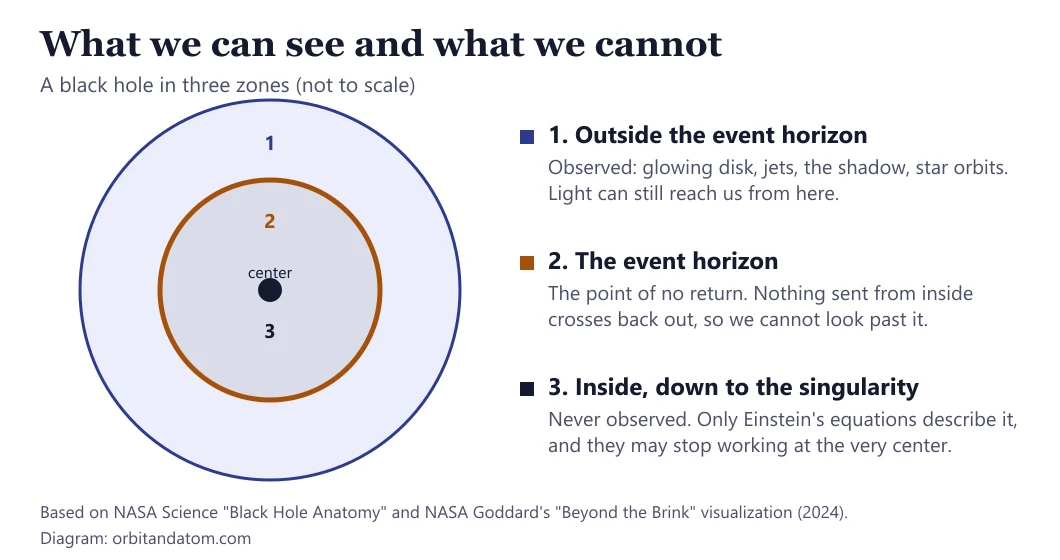
That is the frame for everything below. Zone 1 is observed, zone 2 is the line we cannot see past, and zone 3 is described by mathematics alone.
What would you feel when crossing the event horizon?
It depends on the size of the black hole, and the answer is not what most people expect. NASA Goddard astrophysicist Jeremy Schnittman, who made NASA's plunge simulation, put it this way: "If you have the choice, you want to fall into a supermassive black hole." Stellar-mass black holes, he explained, "possess much smaller event horizons and stronger tidal forces, which can rip apart approaching objects before they get to the horizon."
Tidal forces are the key. NASA describes them as the difference in gravitational pull between the near and far sides of an object, the same effect that makes the Moon raise ocean tides. Near a black hole, the part of you closer to it feels a stronger pull than the part farther away, so you are stretched into a long, thin shape. This is spaghettification, a name NASA traces to Stephen Hawking's book A Brief History of Time.
Size matters because a smaller horizon comes with stronger tidal forces. The simulated black hole in NASA's visualization has 4.3 million times the Sun's mass, like the one at the center of our galaxy, and its event horizon spans about 16 million miles (25 million kilometers), roughly 17% of the distance from Earth to the Sun. A stellar-mass black hole is born in the supernova of a massive star, and neutron stars are the other dense remnant such explosions leave behind.
How long does the fall take?
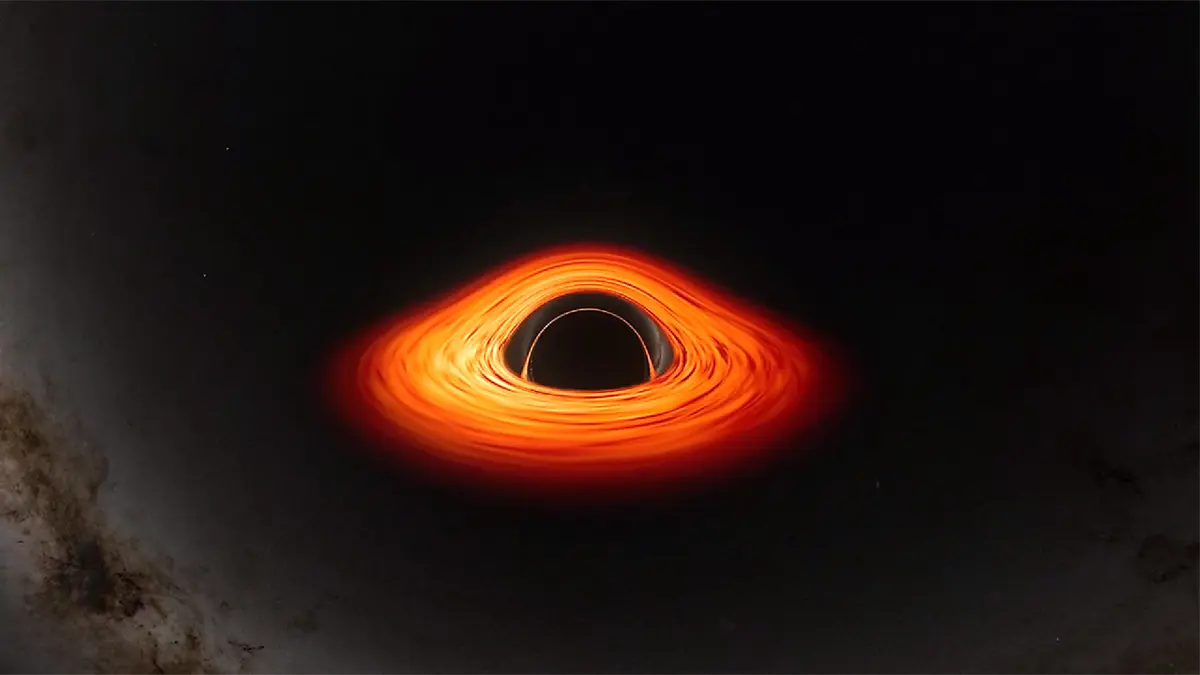
Surprisingly short once you cross the line, and long before it. NASA's team simulated a camera, a stand-in for an astronaut, falling toward the 4.3-million-Sun black hole. The run used about 10 terabytes of data and took about 5 days on NASA's Discover supercomputer.
| Stage | What the simulation shows |
|---|---|
| Start | The camera is nearly 400 million miles (640 million km) away |
| Approach | About 3 hours to reach the horizon, with almost two 30-minute orbits on the way |
| Seen from far away | The camera slows and seems to freeze just short of the horizon |
| At the horizon | Space-time itself flows inward at the speed of light |
| After crossing | Spaghettification is 12.8 seconds away; the singularity is 79,500 miles (128,000 km) from there, "in the blink of an eye" |
The fall in NASA's simulation (a non-rotating black hole, with a camera as the traveler). Source: NASA, "New NASA Black Hole Visualization Takes Viewers Beyond the Brink" (May 6, 2024).
Two things stand out. First, NASA says that once the camera is inside, "both the camera and the space-time in which it's moving rush toward the black hole's center." Second, this is a simulation of the equations, not a test. It tells us what Einstein's theory predicts, which is exactly what we cannot yet check from inside.
Why does time seem to freeze at the edge?
Because gravity slows time. NASA explains that massive objects curve space-time, so time passes more slowly closer to a black hole than farther away. To an observer far off, the falling camera slows down and appears to stop just short of the horizon. That is why astronomers once called black holes "frozen stars."
For the traveler there is no freeze. The same simulation has the camera reach the horizon in about 3 hours of its own time. NASA also ran a second scenario in which the camera swings close, then escapes: on a 6-hour round trip, an astronaut would come back 36 minutes younger than colleagues who stayed far away. For a rapidly rotating black hole, Schnittman said, she would return "many years younger." My guide to time dilation covers the same effect with GPS satellites.
Inside the horizon, the direction of time takes on a new meaning. UC Davis astrophysicist Brenna Mockler said: "Once you're inside the black hole, your timeline is pointed inwards. Light can't escape anymore, so all the photons are moving inwards. You're also moving inwards." She added that light can still get in, so a traveler would keep seeing events far away. And she was clear about the status of all this: "No one knows what happens when an object falls into a black hole."
What is at the center of a black hole?
General relativity says a singularity: a point where matter is crushed to infinite density. NASA says it is the final destination for anything falling past the event horizon. In 1965, Roger Penrose proved that black holes really can form, and the Nobel Committee notes that "at their heart, black holes hide a singularity in which all the known laws of nature cease."
The key word is "predict." NASA says astronomers do not know whether the singularity is a physical structure or only a mathematical one. It adds that the prediction may signal the limits of relativity, "where quantum effects not included in the theory become important in a more complete description of gravity." In my opinion, that is the most important sentence in NASA's description of a black hole. It says the center is not a thing we found, but the place where our best theory of gravity runs out. For more on that theory and its gaps, see what gravity is.
What might replace the singularity?
Nobody knows, but physicists have proposed several ideas. Cosmologist Paul Sutter laid out three in an Expert Voices piece for Space.com (first published in 2020, last updated in 2022). I read it as one scientist's survey, not as a consensus.
| Idea | The claim | Status |
|---|---|---|
| Planck star | Matter cannot be squeezed below a smallest size, so it rebounds instead of forming a point | Comes from loop quantum gravity, itself "highly hypothetical" |
| Gravastar | A ball of dark energy with no singularity; matter would sit on its surface | Gravitational-wave data from mergers have "potentially ruled out" the idea |
| Spinning black hole | Spin stretches the singularity into a ring, with an inner horizon inside | The same math predicts that inner horizon is unstable, which suggests the math is incomplete |
Three ideas for the center, as summarized by Paul Sutter for Space.com (updated February 8, 2022). All are hypotheses.
Sutter's own summary is blunt: "What's really happening inside a black hole? We don't know — and the scary part is that we may never know." The same math for spinning black holes has led to popular stories about passing through to another universe. Sutter notes the equations that produce it also predict an unstable interior, so I would treat those stories as imagination, not findings.
Has anyone seen a black hole tear something apart?
Yes, from the outside. NASA says stars that stray too close to a supermassive black hole can be pulled apart in what astronomers call a tidal disruption event. In one NASA simulation, eight model stars approach a virtual black hole of 1 million Suns. Some are ripped into a stream of gas and others survive, depending on how dense each star was to begin with.
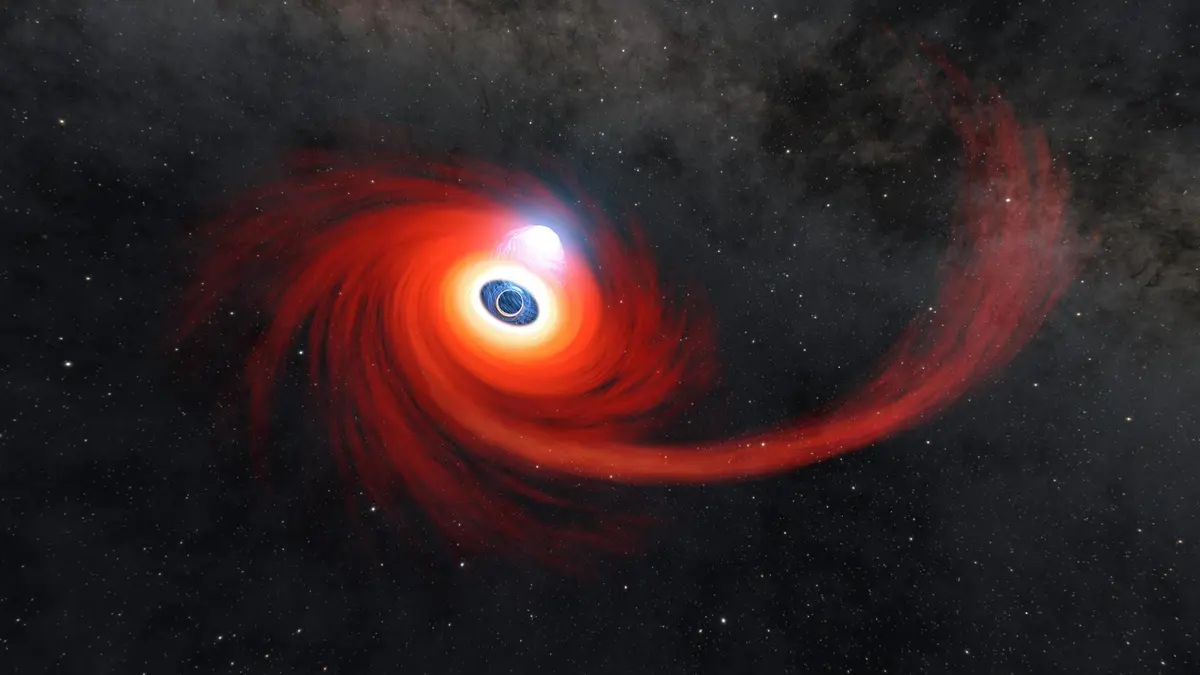
Mockler explains why this matters. A star near a black hole feels tidal forces by the same physical calculation as Earth feels from the Sun and Moon; the source of gravity is just much stronger. When the star is shredded, its gas lights up the region and lets astronomers study the black hole. In my view, these flares are the closest thing we have to watching spaghettification, always from a safe distance and always outside the horizon.
What happens to the information that falls in?
This is the biggest open question about the inside, and it is a quantum one. In the 1970s, Hawking showed that black holes should slowly lose energy as Hawking radiation. NASA says black holes can evaporate this way in theory, but for the ones we know about it would take much longer than the age of the universe.
The trouble, as Wikipedia summarizes the physics, is that Hawking's calculation suggested the radiation would carry no details about what fell in, only the black hole's mass, charge and spin. That would destroy information, which breaks a core rule of quantum mechanics. The article says it is now generally believed that information is preserved, but physicists still differ on exactly how. It remains an unsolved problem, and it is one reason the inside of a black hole matters beyond curiosity: it is where relativity and quantum physics meet.
So what do we know and what do we not?
The outside is well understood, the horizon is a firm prediction, and the center is open. This table sorts the claims by how well each one is supported.
| Claim | Status |
|---|---|
| Black holes exist | Strong evidence; the only known explanation for the central object in our galaxy (Nobel Committee) |
| Nothing escapes past the event horizon | A firm prediction of relativity |
| Tidal stretching near black holes | Modeled in detail; star-shredding flares are seen from outside |
| A singularity at the center | A prediction that may be only math (NASA) |
| Planck stars, gravastars, ring singularities | Hypotheses |
| Information survives evaporation | Generally believed; the mechanism is debated |
What is supported and what is not. Sources: NASA Science, NASA Goddard, the Nobel Committee, UC Davis, Space.com and Wikipedia, as cited above.
I like this topic because the honest answer is also the interesting one. We can describe the fall, from the first tug of tides to the last blink, and then we reach a boundary that is not about telescopes but about theory. For where black holes fit among the largest structures we know, see my Milky Way guide, and for the distances involved in a light-hour or a light-year, how far a light-year is.
Frequently asked questions
What happens inside a black hole?
No one knows for certain. General relativity says everything past the event horizon is pulled toward a singularity, but NASA says astronomers do not know whether that point is real or only mathematical.
Can you survive falling into a black hole?
Not in any simulation NASA has shown. For a stellar-mass black hole, tidal forces can tear an object apart before it reaches the horizon, and in NASA's supermassive example the camera is destroyed 12.8 seconds after crossing.
What is the singularity?
It is the point at the center where general relativity predicts matter is crushed to infinite density. NASA says it may be a physical structure or only a mathematical one, and it may signal the limits of relativity.
How long does it take to fall into a black hole?
In NASA's simulation of a 4.3-million-Sun black hole, the camera takes about 3 hours to reach the event horizon. After crossing, spaghettification comes 12.8 seconds later.
Does time stop inside a black hole?
No. Seen from far away, a falling object seems to freeze at the horizon because gravity slows time. For the traveler, NASA's simulation has the horizon reached in about 3 hours of the camera's own time.
Can anything escape a black hole?
Not from inside the event horizon. Hawking radiation would let a black hole slowly lose energy, but NASA says that would take much longer than the age of the universe for the black holes we know.
Is there another universe inside a black hole?
There is no evidence for it. The math of spinning black holes has led to the idea, but Paul Sutter notes the same equations predict an unstable interior, which suggests the math is incomplete.
Sources
- NASA Science, "What Happens When Something Gets 'Too Close' to a Black Hole?" (published May 3, 2023; last updated May 5, 2026; accessed November 22, 2026). Used for tidal forces, spaghettification, time dilation and tidal disruption events.
- NASA, "New NASA Black Hole Visualization Takes Viewers Beyond the Brink" (May 6, 2024; accessed November 22, 2026). Used for the simulated fall, its numbers and the Schnittman quotations.
- NASA Science, "Black Hole Anatomy" (accessed November 22, 2026). Used for the singularity.
- NASA Science, "10 Questions You Might Have About Black Holes" (accessed November 22, 2026). Used for Hawking radiation and evaporation.
- Nobel Prize in Physics 2020, press release (October 6, 2020; accessed November 22, 2026). Used for Penrose, Genzel and Ghez and the committee quotations.
- UC Davis, "What Happens Inside a Black Hole?" by Greg Watry (January 21, 2026; accessed November 22, 2026). Used for Brenna Mockler's comments.
- Space.com, Paul M. Sutter, "What happens at the center of a black hole?" (Expert Voices; first published October 27, 2020, updated February 8, 2022; accessed November 22, 2026). Used for the three ideas, attributed to the author.
- Wikipedia, "Black hole information paradox" (accessed November 22, 2026). Used as a summary of the current state of the question.
- NASA/JPL-Caltech, "A Black Hole Destroys a Star (Illustration)" (PIA25440; December 20, 2022).

Founder and editor, Orbit and Atom
I write Orbit and Atom to explain space and science in plain English, starting from what NASA, ESA and the mission teams publish. Every article lists its sources at the end so you can read them yourself.